Learning to play a musical instrument sharpens the brain in unique ways. It requires combining technical skill with creative expression, which helps develop new ways of thinking and problem-solving.
The practice of mastering an instrument trains the mind to approach challenges more creatively by enhancing pattern recognition, memory, and emotional expression. This process encourages flexible thinking beyond rigid structures.
As musicians explore different sounds and rhythms, they build connections between diverse ideas. This cultivates a mindset open to innovation and original thought, extending creativity far beyond music alone.
How Learning an Instrument Fosters Creative Thinking
Learning to play an instrument actively engages the brain in ways that develop creativity through structured expression, spontaneous innovation, and analytical problem-solving. Musicians refine their ability to think flexibly and approach challenges in original ways, essential traits for creative thinking.
Creative Expression and Imagination
Playing an instrument allows individuals to translate abstract emotions and ideas into melodies and harmonies. This process requires imagination to craft unique sounds and musical phrases, helping musicians develop skills in expressing complex concepts without words.
Through techniques like dynamics, articulation, and phrasing, learners shape the emotional impact of their music. This fosters a deeper understanding of nuance and subtlety, which extends to creative tasks beyond music.
Improvisation and Innovation
Improvising involves creating music spontaneously, demanding quick thinking and risk-taking. Musicians must draw on their knowledge of scales, chords, and rhythm while inventing fresh variations on the spot.
This practice enhances innovation by encouraging experimentation and breaking away from rigid structures. It also cultivates comfort with uncertainty and an ability to adapt ideas rapidly, which can transfer to other forms of creative problem-solving.
Problem-Solving Through Musical Exploration
Musicians often face challenges such as mastering difficult passages or creating balanced compositions. This requires breaking down problems into manageable parts and applying critical thinking to improve technique or musical coherence.
Learning an instrument promotes iterative exploration — trying different approaches, evaluating results, and refining skills. These processes strengthen overall problem-solving abilities, as musicians develop persistence and analytical thinking through hands-on musical experiences.
Cognitive and Academic Advantages of Musical Training
Musical training affects various mental processes linked to academic success and cognitive growth. It enhances skills such as memory, focus, problem-solving, and language, all of which contribute to improved learning outcomes.
Memory and Focus Enhancement
Learning music requires active engagement with complex patterns, strengthening both auditory and visual memory. Musicians develop better working memory, which helps them retain and manipulate information more effectively.
Sustained attention is also improved through regular practice, as reading music and coordinating hand movements demand continuous concentration. This heightened focus transfers to academic settings, where students can maintain attention during lectures and tasks.
Additionally, music education enhances the brain’s ability to filter distractions, leading to improved cognitive control. These memory and focus skills support overall brain development and educational performance.
Boosting Executive Function and Multitasking
Musical training develops executive functions, which include planning, flexible thinking, and self-control. Playing an instrument often requires reading music, timing notes, and listening simultaneously, improving multitasking abilities.
This coordination strengthens neural pathways associated with cognitive control and problem-solving. Musicians demonstrate enhanced ability to switch between tasks and manage complex activities without losing efficiency.
Improved executive function also aids communication by enabling better organisation of thoughts and responses. These skills are crucial in academic environments for managing workload and adapting to new challenges.
Improving Mathematical and Language Skills
Music education correlates with stronger mathematical abilities, particularly in understanding fractions and ratios. Reading music involves recognising note durations and rhythms, which parallels mathematical fraction concepts.
Musicians often excel in pattern recognition and sequencing, foundational for maths problem-solving. This link between music and maths supports better academic performance in numerical subjects.
Furthermore, musical training improves language skills by enhancing auditory discrimination and verbal memory. These skills contribute to better communication, reading comprehension, and vocabulary acquisition, all important for academic success.
Building Discipline, Confidence, and Emotional Intelligence
Learning an instrument requires consistent effort and time, which fosters a range of personal skills. These skills include perseverance through challenges, building confidence via performance, and developing emotional awareness through musical expression.
Developing Perseverance and Discipline
Regular music practice demands routine and commitment. Students must set aside time daily or weekly, learning to manage distractions and overcome frustration when pieces prove difficult.
This consistent discipline teaches the value of steady effort. Facing challenges in music lessons cultivates perseverance, which translates to other areas requiring persistence, such as academic or professional goals.
Structured practice sessions also encourage goal-setting, patience, and self-regulation. These qualities strengthen as the learner progresses, reinforcing the link between discipline and creative improvement.
Increasing Self-Confidence Through Performance
Performing music publicly or in lessons boosts self-confidence. Musicians learn to manage stage anxiety and present their skills clearly to an audience, even if small.
Each successful performance reinforces a sense of accomplishment. This positive feedback motivates continued practice and ambitious goal-setting, essential for creative growth.
Confidence gained in performance often impacts other social situations, improving communication and self-assurance without reliance on external approval.
Emotional Expression and Empathy
Playing an instrument offers a direct way to express emotions nonverbally. This process can enhance emotional intelligence by helping players identify and convey feelings.
Moreover, interpreting music composed by others develops empathy. Understanding emotional nuances in compositions strengthens the player’s ability to connect with diverse perspectives.
Music therapy utilises these elements to support emotional well-being, showing how emotional expression through music can aid personal and social development.
Social and Physical Transformation Through Music
Playing an instrument fosters growth in social abilities and physical capabilities simultaneously. These developments enhance interaction with others and improve precise motor functions, which are essential for both music and daily tasks.
Collaboration and Ensemble Skills
Participation in ensembles requires attentiveness to others’ timing, dynamics, and pitch. Musicians learn to synchronise their playing, developing skills in collaboration and non-verbal communication. This collective effort improves listening skills and adaptability.
Working in groups teaches responsibility, as each member’s contribution affects the overall performance. The process encourages empathy and patience, crucial traits for working effectively in teams beyond music.
Enhancing Motor Skills and Coordination
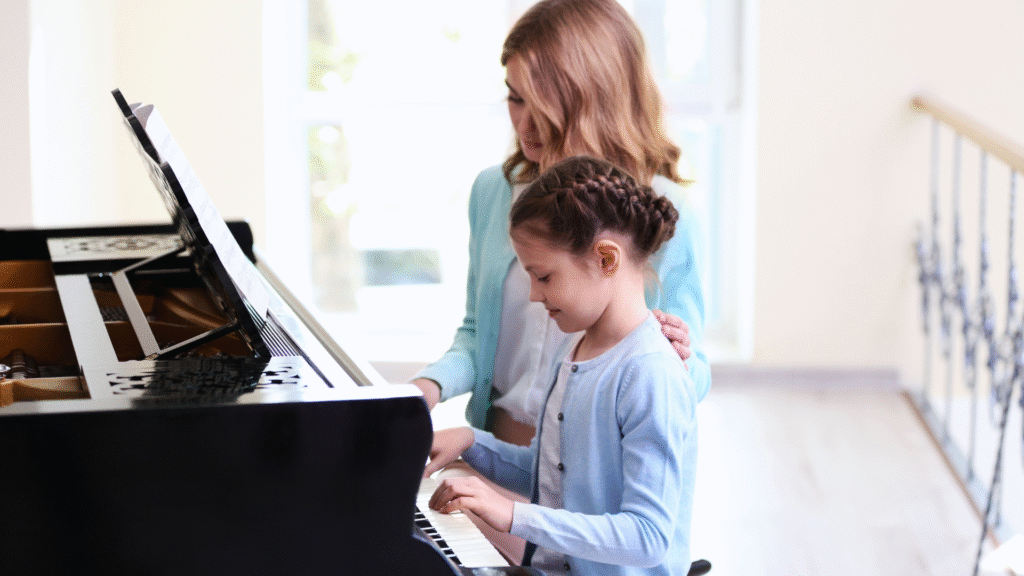
Instrument playing demands refined motor control, especially in the fingers, hands, and arms. These actions enhance fine motor skills and hand-eye coordination through repeated practice of precise movements.
Rhythm and timing coordinate with physical movement, improving overall motor skills. Early childhood learning, when motor pathways are developing, shows significant improvement compared to starting later. Regular practice rewires and strengthens these physical skills.
Neural Connections and Neuroplasticity
Musical training stimulates multiple brain areas involved in hearing, movement, and memory. This activity encourages the formation of new neural connections, enhancing cognitive functions.
Neuroplasticity allows the brain to adapt and reorganise with musical practice, aiding problem-solving and creative thinking. The integration of pitch, rhythm, and motor demands supports long-term cognitive resilience.